


What to do if...
Click the green buttons below to learn more about each topic and local resources available.
You suspect cruelty/neglect…
Are you aware of or suspect neglect, abandonment or cruelty involving an animal? Second Chance Animal Sanctuaries is not qualified to investigate such cases and the county is currently without a humane law enforcement officer. Start by calling your local or state police precinct, who can make contact with Second Chance if they need placement for an animal.
The following is not a complete list, as some stations may be defunct, no longer exist, or may be in the process of reorganizing/hiring.
- Pennsylvania State Police, Mansfield barracks - 570-662-2151
- Elkland Police Department - 814-258-5419
- Gaines Township Police Department - 814-435-1133
- Lawrence Twp Police Department - 570-827-0212
- Lawrence Police Department - 570-827-2000
- Knoxville Boro Police Department - 814-326-4126
- Mansfield Borough Police Department - 570-662-2315
- Osceola Township Police - 814-258-5301
- Wellsboro Borough Police - 570-724-4400
- Westfield Borough Police Department - 814-367-2769
You lose an animal…
- Search your house. Unless you physically saw your cat or dog go running out the door, first search every nook and cranny in your home. If you did see them go outside, search in and under any outbuildings, garages, sheds, basement, porches, roof, under/in your car, bushes, trees, etc. If possible, leave sheds or garages cracked open ,as cats especially will likely seek shelter close to home.
- Go door-to-door and ask neighbors. Show them photos of your cat or dog and ask them to search their property and keep a look out in the community.
- Post online (include a photo, area/time missing and how to contact you). Put it on your personal social media, as well as any relevant community pages/groups. If you're in Tioga County, post to these lost pet Facebook groups:
- Call shelters/rescues and veterinarians and local authorities such as police, animal control and the humane officer. In and around Tioga County:
-
Rescues/shelters (please contact before showing up with animals; some of the below are private rescues and not open to the public):
- Second Chance Animal Sanctuaries (dog/cat rescue/shelter), 725 Gee Rd., Tioga, PA 16946 - 570-376-3646, secondchanceas@yahoo.com, or message on Facebook. Please note we are the only facility in Tioga County licensed by the state to take in stray dogs.
- The Humane Center (dog/cat rescue), Mainesburg - humanelawtioga@gmail.com or message on Faceboook
- Hobos Home (cat rescue), Millerton - hoboshome2020@yahoo.com or message on Facebook
- Cause4Paws (cat rescue/fosters), Covington - 540-538-0707, cause4paws16933@gmail.com
- Tioga County Cat Project (cat TNR & cat/dog foster), Lawrenceville - tiogacountycatproject@gmail.com or message on Facebook
- Teacher's Pet Rescue, Coudersport - 814-274-0383
- Animal Care Sanctuary, Milan - 570-596-2200
- Happy Tails, Towanda - 570-485-9750
- Bradford County Humane Society, Ulster - 570-888-2114
- Paradise Garden, Woodhull, NY - 607 458-5785
- Stray Haven Humane Society, Waverly, NY - 607-565-2859
- Chemung County Humane Society, Elmira, NY - 607-732-1827
-
Animal officials:
- Dog Warden (handles dogs running at-large, not abandonment or abuse/neglect): Joshua Fritz (Tioga & Potter counties) - 570-407-6769.
- Click here to look up any Pennsylvania dog warden.
- NOTE: As of March 2026, Tioga County has no humane law enforcement officer or animal control.
-
Veterinarians - click HERE
- Police departments - click HERE
-
Rescues/shelters (please contact before showing up with animals; some of the below are private rescues and not open to the public):
- Report to your microchip company. Most have an option online to report your pet missing, which will then alert anyone who scans the animal for a chip. If you're not sure of your pet's microchip company, ask the veterinarian or rescue that inserted it, or ask the animal's former owner.
- Make flyers. These are helpful for handing out to neighbors, posting online or hanging around the neighborhood. Find a template here.
- Procure a trap and set up feeding stations. If you're getting sightings of your pet, but can't catch them, contact a rescue, dog warden or humane officer to ask if they have a trap available. Set up feeding stations where your pet has been seen, and once you know they're eating there, move food inside the trap.
You find an animal...
If you find a stray dog or cat, there are steps that need to be taken to ensure that both you and the animal are safe and protected.
- Approach the animal cautiously. Observe its behavior for possible aggression (could be purely out of fear) or for possible disease/injury. Do not call to it, chase it on foot or in a vehicle, as that could scare it away further from the area or even into traffic. Kneeling/sitting down at its level, speaking in a soft voice and offering a treat can sometimes help.
- If it's an animal you can SAFELY leash, pick up or corral into a vehicle or building, confine it as soon as possible.
- If the animal has a collar and tags, first check for an owner number. If it's a dog with a license tag, call the County Treasurer's Office at 570-724-9213 with the license number for owner identification.
- Contact folks in the neighborhood, go door-to-door or stop at nearby businesses to see if anyone recognizes the animal or if anyone has reported a similar one missing.
- Post the animal to local lost pet groups on Facebook (find links in the section above). Include a clear photo, where and when the animal was found, and how to contact you if it's in your possession. In certain areas, other social media apps or neighborhood apps like Nextdoor may be more widely used.
- If possible, take the animal to the nearest vet clinic (call them first) to have them scan for a microchip. This service is free, but make sure to call and ask first. We can also scan animals for chips, but please call first to make sure someone is at the sanctuary.
- Call us at 570-376-3646 to report the found animal, even if it's not in your possession. We accept stray dogs into our care, but please call first to make sure someone is at the sanctuary. Most of the time, we cannot accept a found cat right away, as there is an abundance of indoor/outdoor pet cats, ferals, community cats, etc. who roam and live outside, whereas dogs do not. We do have a wait list to take in stray cats, so please call us.
- If it's a dog, contact the dog warden (NONE CURRENTLY IN TIOGA COUNTY) to report a found animal. If it's a dog still running at large, the dog warden may respond to the scene.
- Call local radio stations (WNBT at 570-724-1490; KC101 at 570-662-9000) and describe the dog and the location where it was found. Make sure to leave your phone number.
- Lastly, be patient. This can be a stressful situation for both you and the animal. If you intend on keeping the animal until the owner is found, provide the animal with food, water and shelter. Many times, the owner is found within a day or two. You've done a really good thing tending to the animal in the meantime.
You need to rehome an animal...
On any given day, countless people are looking to rehome their pets for any number of reasons. Shelters and rescues are already in population crisis mode, so they're rarely able to keep up with the demand. First and foremost, we urge you to exhaust all other options to keep the animal in the home it knows - vet appointments, medications, training, lifestyle changes, food changes, etc. Life happens and not every option is feasible or accessible to every person, but your pet deserves the effort. Reach out to us if you need suggestions.
If you must rehome, consider these tips to do so more safely*:
Preparing your pet
Before your pet is rehomed:
- SPAY/NEUTER - To avoid even more animals needing homes, please consider getting your pet fixed prior to rehoming if they aren't already. Contact us for local low-low-cost options or for info about our partial financial assistance program. Alternatively, in place of a rehoming fee, ask the new owners to pay for the surgery (but meet them at the vet appointment and bring the animal yourself to ensure it's done).
- Microchip - Get your pet chipped if they aren't already. Switching the chip to the new owner's info is usually pretty simple using the chip company's website. Or, meet them at the vet when you get it done so they can register their info.
- Get up to date on vaccines
- Gather all medical records, rabies tag, spay/neuter certificate, microchip info, etc.
- Refill medications
- Record any specific routines, instructions, likes/dislikes, and their food and any supplements or medications
- Groom and bathe
How to find a potential adopter
Contact shelters and rescue groups in your area. Again, they're generally at capacity across the country, but they still may be able to help. They may already have an approved adopter looking for that type of animal, may be able to add you to their surrender waiting list or may be able to post the animal on their website or social media pages. If you're able, ask if they'd consider making you a “foster home” for the animal while it awaits an adopter.
Contact larger rescue groups out of your area (if you or they offer transport) or Google breed-specific rescues if your dog or cat is of a specific breed. Do some research on the rescue to make sure it's legitimate.
Check with family, friends, trusted co-workers, etc. You never know who may be looking to add a new furry friend, and your pet is better off with someone you know and trust, and someone they may already know as well.
Check with your veterinarian, groomer or other trusted animal professional. They have some insight into how their clients treat their pets, and may know of a trusted person looking to adopt.
Consider a reputable online rehoming service such as Rehome by AdoptaPet. While the quality of adopters found online can't be guaranteed, these sites are generally better than social media.
We hope social media (beyond your private profile for people you know) is the last resource used in seeking a new home for your pet. It's difficult to know what kind of home your pet is going to if given to a “random” person online. Sadly, some people even seek out pets to hoard, harm or use as bait. However, if all other options are exhausted, there are further steps to take to determine if the home could be a good match, such as asking lots of questions, checking references or even conducting a home visit.
What to ask potential adopters
- Their contact info - full, real name (if they contacted you online), address, phone number, email.
- Why do you want to adopt a pet?
- What made you interested in my pet?
- What do you think are the most important responsibilities in having a pet?
- What pets are currently with you? Are they spayed/neutered and up to date on vaccines? Are they friendly toward other animals?
- What pets were previously with you and what happened to them? (i.e. did they die of old age, go missing, were rehomed)
- What people live in or frequently visit the home, along with their ages and relationship to you (the adopter)?
- Does anyone in the home have animal-related allergies?
- Do you own or rent your home? If rent, please provide landlord's name and phone number.
- Do you have a fenced-in yard?
- Where will the animal be kept at night? During the day?
- How many hours per day on average will the animal be alone? Where will they be kept at that time?
- Are you able to meet financial needs of having a pet, such as regular vet visits, flea/tick medication, food, emergency costs, etc.?
- If I rehome to you, may I contact you periodically to check in on the pet?
- What will happen to the pet if your life circumstances ever change? (move, have children, get another pet, fall ill, etc.)
- Are there any circumstances that would ever cause you to rehome a pet?
- References: 1) Veterinarian's name and phone number, and whose name the pets' files are under; 2) At least three personal references, two not related to you, with phone numbers.
Contacting references
It may feel awkward or like overkill, but nothing should be when it comes to the wellbeing of your pet.
Veterinarian: Tell veterinarian's offices you're considering rehoming a pet to their client. Ask how many pets the person brings to see them, if they're spayed and neutered, up to date on vaccines, in general good health or being treated for any conditions. Ask how their current pets' demeanors are at the office. Ask if they'd have any misgivings about adopting a pet to the person.
Personal: Ask personal references how long they've known the person, if they're been to their home and met any current or past pets, and if they've witnessed interactions between the person and any animals. Ask if they believe the person is financially equipped to adopt a new pet. Ask if they would personally allow this person to adopt one of their own pets.
Landlords: Ask landlords if the person is allowed to have pets (or an additional one) at their place of rental. It also doesn't hurt to ask them some of the same things as the personal references.
Home visits/meet and greets
You are absolutely entitled to ask if you can come visit the home of a potential adopter. Not all will agree, which to some could be taken as a red flag. If you do so, do it safely and bring another person with you. If possible, do not bring your animal the first time you go to the home. Here are some things to consider:
Note the outside of the home. Is it on a busy street, is there a fenced-in portion, are there any visible broken doors or windows which an animal could escape from? Are there any kennels, pet shelters or leads tied outside and what condition are those items in? Are there currently any pets outside and do they have access to food, water and shelter?
Note the inside of the home. Is it reasonably clean, are there any broken windows or doors, any items laying out that could harm a pet? Do pets have access to food and water? Are litter boxes clean? Do existing pets have toys, beds, other comforts, etc.? Ask to see where the pet would be kept at night, during the day and when home alone.
Consider who is home at the time and how they interact with any existing animals. Meeting with everyone who lives there (humans and animals) is best, if possible.
If you've already spoken to the person/people and asked questions, ask some of the same ones again to check for consistency.
If bringing your dog for a meet and greet with existing dogs, consider doing so first on “neutral ground” such as another person's yard or at a public dog park. The first time your dog meets the existing dogs should not be when they're officially being adopted/dropped off/taken. Cats generally do not require meet and greets, except to see if an existing dog is friendly toward cats.
Rehoming fees
Rehoming fees on their own don't necessarily guarantee a good home for an animal, but it may help demonstrate that the person is seriously interested and has some financial means to care for the animal. Consider what fees your local shelter or rescues ask. Alternatively, if your pet isn't yet fixed, consider meeting the new owners at the appointment for surgery and having them cover it in place of a rehoming fee.
Try not to view this as a way to “make money” for yourself, but rather another tool to ensure your pet has the best chance at a good and stable life. Remember that scams are still always possible, such as bounced checks or counterfeit cash. That's one reason why establishing a relationship and checking in to the person first are important.
Checking in
Check in to see how the animal is doing after a couple of days, a week, a month, etc. No need to check every day unless the adopter and you are open to that kind of communication (it's great when they are!). Remind them of the 3-3-3 rule (how long it takes a pet to settle in to a new home). Decide beforehand if it doesn't work out with the new adopter, if you are willing and able to take the animal back to start the process over again. Every time an animal is rehomed to a new environment with new people, their spirit, demeanor and behavior can change, and usually not for the better. As for visiting, sometimes it's not good for animals, especially dogs, to see a former owner they lived with for a long time…imagine how confusing that is for them. Unless you already have such a relationship with the adopter, or plan to keep one up, OR if you're concerned for the animal's wellbeing in its new home, visiting after rehoming is more for your benefit, not the animal's.
*Disclaimers
The above are merely suggestions and tips for rehoming a pet only if absolutely necessary. In no way do following these tips 100% guarantee a good home for an animal. Second Chance Animal Sanctuaries, its board, employees or volunteers bear no responsibility for anything that happens to a pet you rehome on your own, should you follow any of the above suggestions and tips. The above is not an exhaustive list of all options for rehoming an animal or steps to ensure a safe home. This page is subject to edits, additions and deletions at any time.
Online resources
https://www.humanesociety.org/resources/need-find-your-pet-new-home
https://www.petsforpatriots.org/how-to-rehome-your-pet-responsibly-humanely/
Your pet needs vet care…
Please note that Second Chance Animal Sanctuaries does not have a veterinarian on staff. If you own or find an animal in urgent need of vet care, please contact one of the below resources. The below is NOT a complete or exhaustive list.
LOCAL VETERINARIANS
- Grand Canyon Veterinary, Wellsboro - 570-724-0700
- Wellsboro Pet Complex - Wellsboro (offers some night/weekend/after-hours emergency care) - 570-724-3841
- Wellsboro Small Animal Hospital - 570-376-2800 (Middlebury) & 570-662-7655 (Mansfield)
- Pleasant Valley Veterinary Care, Elkland - 814-258-5719
- Mansfield Veterinary Clinic, Mansfield - 570-662-3844
- Northern Tier Veterinary Clinic, Knoxville - 814-326-4145
- Troy Veterinary Clinic, Troy - 570-673-3181
- Potter County Veterinary, Coudersport - 814-274-0857
- Lewis Veterinary Clinic, Linden (Second Chance utilizes for spay/neuter) - 570-326-9640
EMERGENCY VETERINARIANS (established extended hours or 24/7)
- Animal Emergency Center, Watsontown - 570-742-7400
- VCA Metzger Animal Hospital, State College - 814-237-5333
- Cornell University Veterinary, Ithaca, NY - 607- 253-3060
- Enchanted Mountains Urgent Care, Olean, NY - 716-257-4830
LOW-COST VETERINARY CLINICS
- Spay Neuter Save Network, Rome (hosts some mobile cat spay/neuter clinics in Tioga County) - 570-247-8383
- Animal Care Sanctuary, East Smithfield (no longer has a Wellsboro facility) - 570-596-2200
- Chemung County Humane Society, Elmira, NY - 607-732-1827
POISON CONTROL (national resources)
- ASPCA Animal Poison Control Center - 1-888-426-4435
- Pet Poison Helpline - 1-855-764-7661
IF YOU CANNOT AFFORD VET CARE
- Ask your vet about applying for Care Credit or if setting up a payment plan is possible.
- Second Chance has programs to assist residents of Tioga County, PA, with paying for veterinary bills, including spay/neuter, vaccines, surgeries, end-of-life services, etc. In many cases, we can cover a portion of a bill, paid directly to a veterinarian (not reimbursed to you, or paid after care) on case-by-case basis. BEFORE YOUR VETERINARY APPOINTMENT, call us at 570-376-3646 or email secondchanceas@yahoo.com.
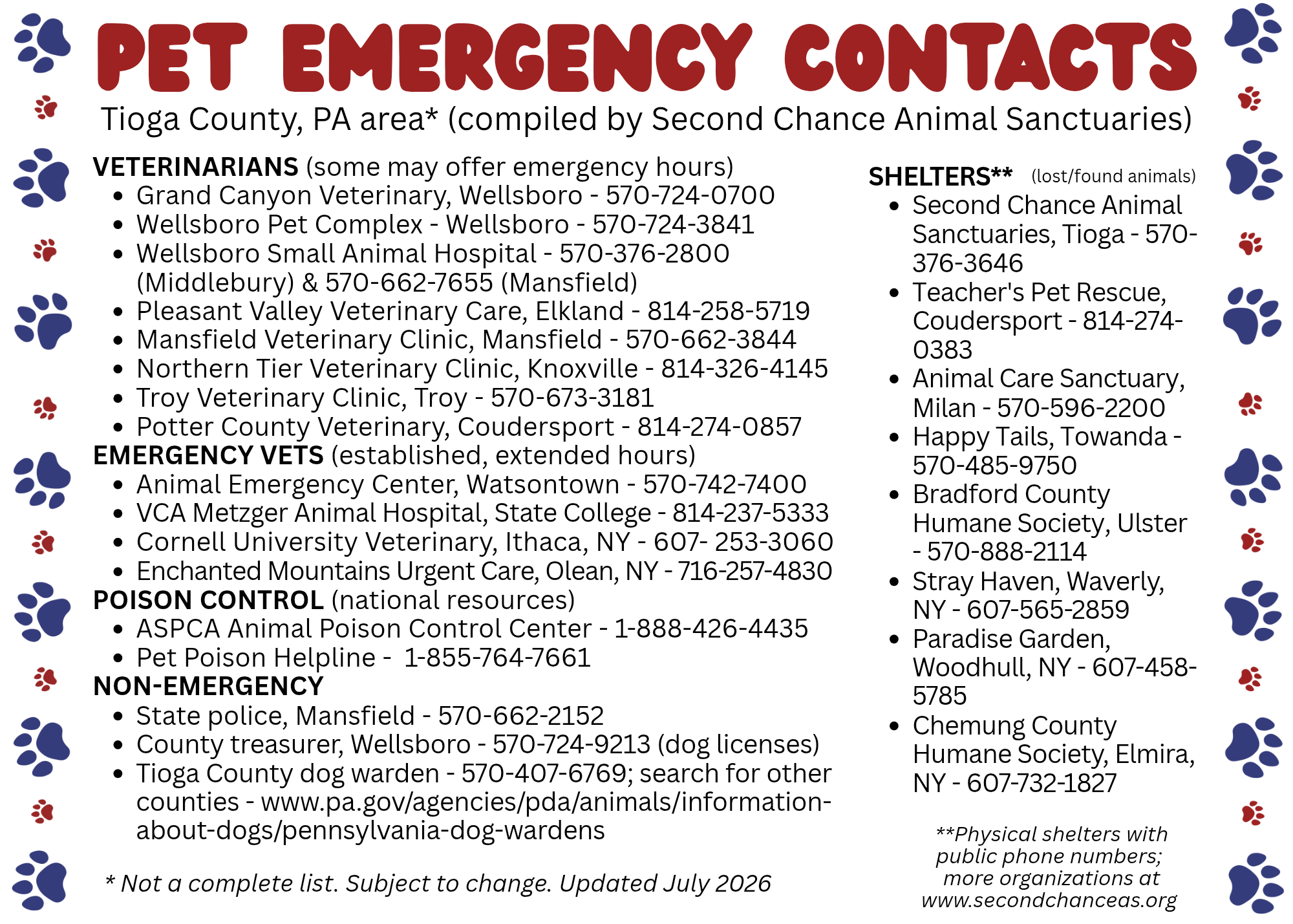
Click the list above to download it.
You own a senior dog...
If you live in Tioga County, PA, and need help caring for your senior dog, whether with vet care, food, medications or other supplies, call us at 570-376-3646 or email secondchanceas@yahoo.com.
If you need to surrender or rehome a senior dog, call us at 570-376-3646 or email secondchanceas@yahoo.com. We have a program geared toward finding hospice, long-term foster or adoptive homes for senior dogs, so we may be able to help.
SENIOR DOG TIPS
Brought to you by our Grey Whiskers program, via a grant from the Grey Muzzle Organization. ALWAYS talk to your veterinarian first before making changes in your pets' care.
- KNOW WHEN THEY'RE A SENIOR: Your veterinarian can help determine this based on your dog's age, breed, size and health. DNA tests can also help determine these factors. Larger breeds have shorter life expectancies, so they're considered seniors at younger ages. In general, these ages are "seniors": Small or toy breeds (less than 20 pounds) - 8 to 11 years; medium-sized breeds (20 to 50 pounds) - 8 to 10 years; large breeds (50 to 90 pounds) - 8 to 9 years; giant breeds (more than 90 pounds) - 6 to 7 years.
- ELEVATE MEALTIME: Elevate your senior dog’s food and water bowls for comfort at mealtime. If your geriatric dog has cervical disc issues (neck problems), back problems or front-end lameness, elevating food and water bowls is a simple modification that often yields immediate results. It prevents the chronic, repetitive straining motion of bending down again and again to floor level to pick up bits of kibble from the dish.
- BATH TIME FUN: Add safety features to your senior dog’s bath time routine if they aren't groomed regularly. If your dog struggles to stay upright on all fours or has decreased muscle strength, put grips on the bottom of the tub, allow them to lay in a shallow tub, or consider waterless shampoo or wipes. Distract them by spreading peanut butter or spray cheese of the walls of the tub they can lick while you scrub them.
- BALANCED TEMPERATURE: Older dogs are more susceptible to temperature extremes - the cold can exacerbate achy joints and pose risk of hypothermia, while warm weather can cause dogs to overheat. When outside, if your dog is shivering and walking more stiffly they're probably too cold. If panting heavily and slowing down, they may be starting to overheat. Addressing these keeps general discomfort from developing into a life-threatening emergency.
- COMFY BED: Making sure your dog has a comfortable and supportive place to rest is even more important as they age. Many have some degree of arthritis pain. Laying on hard floors can put pressure on sore joints, so a quality dog bed is recommended. Check for size, durability, how easy it is to clean, and whether it has enough padding to keep from going flat.
- HYDRATE, HYDRATE, HYDRATE: Senior pets are prone to dehydration, largely because they forget to drink, can no longer easily access their water source, or they aren't retaining fluids properly. Dehydration can exacerbate other major health issues. Ensure your dog has access to fresh, clean water at all times in several different places. Some dogs enjoy water fountains. Wet food can also be a great way to increase water intake, particularly for older animals.
- ADJUST TO LOSS OF SENSES: Many senior pets experience a decline in their vision or hearing. If your pet seems more anxious, is bumping into things, or isn’t responding to calls as they used to, these could be signs of sensory loss. Creating a safe, consistent environment and using other forms of communication, like hand signals or vibrations, can help your pet adjust. Teaching them before they need it can make it easier for when they do.
- CONSIDER SUPPLEMENTS: Supplements can help maintain your senior pet’s health. Always consult your veterinarian before starting your pet of any age on supplements. Common ones include: Glucosamine and Chondroitin support joint health and mobility; Omega-3 Fatty Acids support or a healthy coat and reduce inflammation; probiotics aid in digestion and support a healthy gut. (from brawleyanimal.com)
- RESTRICT ACCESS: Restrict access to potential problem spots in the house. As pets age, their mental and physical faculties decline, which can lead to trouble even in areas they once navigated with ease. Use baby gates to block stairs pr hard-to-navigate rooms. Check your backyard for danger zones, making sure swimming pools, fire pits and window wells are covered. Restrict their access to ponds or barns without supervision. (from humanesociety.org)
- WEAKENED IMMUNE SYSTEMS: Like humans, animals' immune systems weaken as they get older. Keep them up to date on both vaccines and parasite control, as they're not able to fight things off as easily or heal as fast. If your pet has a compromised immune system, no matter their age, avoid taking them to places where lots of dogs you don't know gather, like dog parks or daycare, or pet-friendly establishments.
- SPECIAL DIETS: Senior dogs are less active, and therefore in most cases shouldn't be fed a high-calorie diet. This will help prevent your dog from gaining extra weight that could lead to many health problems. However, some health issues that come with age do require higher calorie diets to help older dogs maintain their weight. Talk to your veterinarian to best understand the right diet for your dog.
- NIGHTLIGHTS: As dogs age, their vision may worsen, sometimes from cataracts or a condition called lenticular sclerosis. Not being able to see well may cause your dog distress, fear, anxiety or injuries if they trip, fall or bump into items. Putting nightlights throughout your home, especially between their sleeping spots or to their water bowl, can help.
- APPROPRIATE EXERCISE: Exercise is a great way to keep your senior dog lean and maintaining a healthy body. As dogs age, just like people, they may no longer be able to perform certain physical activities. Tailor the exercises to your dog and their abilities. If your dog has not been doing exercises for a long time, start slow as you increase the intensity gradually. It is also important to consult a veterinarian to understand the type and duration of exercise suitable for your dog.
- FAMILY ACTIVITIES: Don't leave your senior dogs home just because they're slowing down. Continuing to take them on outings or vacations keeps their bodies and minds active. Create a comfortable space for your pet in the car, drive slowly, invest in a stroller or wagon, and book a pet friendly hotel. You can both slow down and soak up every moment together.
- PLAYDATES: As dogs age, dogs tend to be less active, and some even disengage from social activities. If your dog is too weak to go to the dog park, he’s definitely missing his pals, so try to arrange playdates with his friends. Through this, your dog will socialize, exercise and enjoy being in a less restricted environment, while still feeling comfortable and safe.
- VET VISTS: As dogs get older, their immune system weakens, so it's important to visit the veterinarian at least twice a year. Your older pet may require additional blood tests, dental care, or other examinations. Some breeds are also predisposed to conditions such as hip dysplasia, arthritis, diabetes and cancer. Frequent vet visits can help discover these ailments before they become life threatening.
- DENTAL HEALTH: It is important to maintain the dental hygiene of your aging dog, because mouth health is an indicator of overall health. Be sure to clean your dog’s teeth regularly to prevent dental diseases, decay and chewing problems. If it’s a challenge to do this yourself, opt for dental toys and dental treats, visit a groomer, or ask your veterinarian for more options.
- BEHAVIORAL CHANGES: Dogs can't tell us what's wrong, so we must pay close attention to their behavior. When they're sick or in pain, some dogs get agitated or avoid interaction, while others become more clingy. Decreased appetite, changes in urination and increased water consumption could all mean that your dog is unwell. Talk to your veterinarian right away if you notice any changes in behavior.
- PREVENT OBESITY: As they age, dogs' metabolism slows and activity levels decrease, so it's easier to let some extra pounds creep up. Overweight pets are at a higher risk of diseases such as heart disease, diabetes, cancer and even skin disease. Extra weight also puts more stress on weakening bones and joints. Talk to your veterinarian to formulate a diet and exercise plan for your overweight senior.
- HOME ADJUSTMENTS: If your dog is suffering from joint issues or hip dysplasia, install ramps or stairs so they can climb onto the bed, couch or in your vehicle. Ensure that food and water are where your pets can easily reach them, especially for those with vision impairments. If you live in a cold climate, consider providing your dog with heated beds to keep them warm and soothe achy joints.
- ARTHRITIS: The American Veterinary Medical Association reports that many pets suffer from arthritis, some without their owners ever knowing. The older your dog gets, the more often they should be checked for arthritis. If you notice signs such as decreased activity, difficulty climbing stairs, difficulty sitting or standing and seemingly stiff joints, you should contact your vet.
- PLAY WITH TOYS: You can use toys to keep your old dog occupied and happy, but they provide a health and wellness component, too. Chew toys help strengthen jaw muscles and balls or things you throw encourage full-body movement, promoting a lean, strong body. Problem-solving toys like treat puzzles or snuffle mats help keep minds sharp and their sense of smell in tip top shape.
- KEEP THEM SAFE ON HOLIDAYS: Halloween: Hide the candy! Chocolate or anything with xylitol/birch sugar in it is toxic to animals. Know their boundaries, and if they're not fond of people or kids, keep them inside and away from the door if you're expecting trick-or-treaters. A lot of dogs don't like dressing up and it's not worth their discomfort. Or, keep it to something they may already be used to, like a sweater. Thanksgiving/Christmas: Generally, table scraps aren't encouraged, but be sure to know which can be toxic or even deadly to your dog (chocolate, raisins, garlic/onions, etc.). If you're having company, and your dog isn't a fan of crowds or loud noises, set up a quiet, comfy space for them away from the party. Be sure everyone knows the rules of letting your dog in and out and keeping doors to outside closed. Fourth of July: Fireworks can be terrifying for animals of any age or breed. Keep them inside! If they're especially anxious with loud noises, consider medication by talking to your vet, close them in a room with soothing music playing, and distract them with indoor play or treats. Do not leave them home alone, as frightened dogs have been known to break out of doors or windows to try to escape the noise. In case they do get loose, make sure they are mirochipped and that info is up to date, their collar is on and their tags are up to date with your contact info.